When Your World is (Literally) on Fire
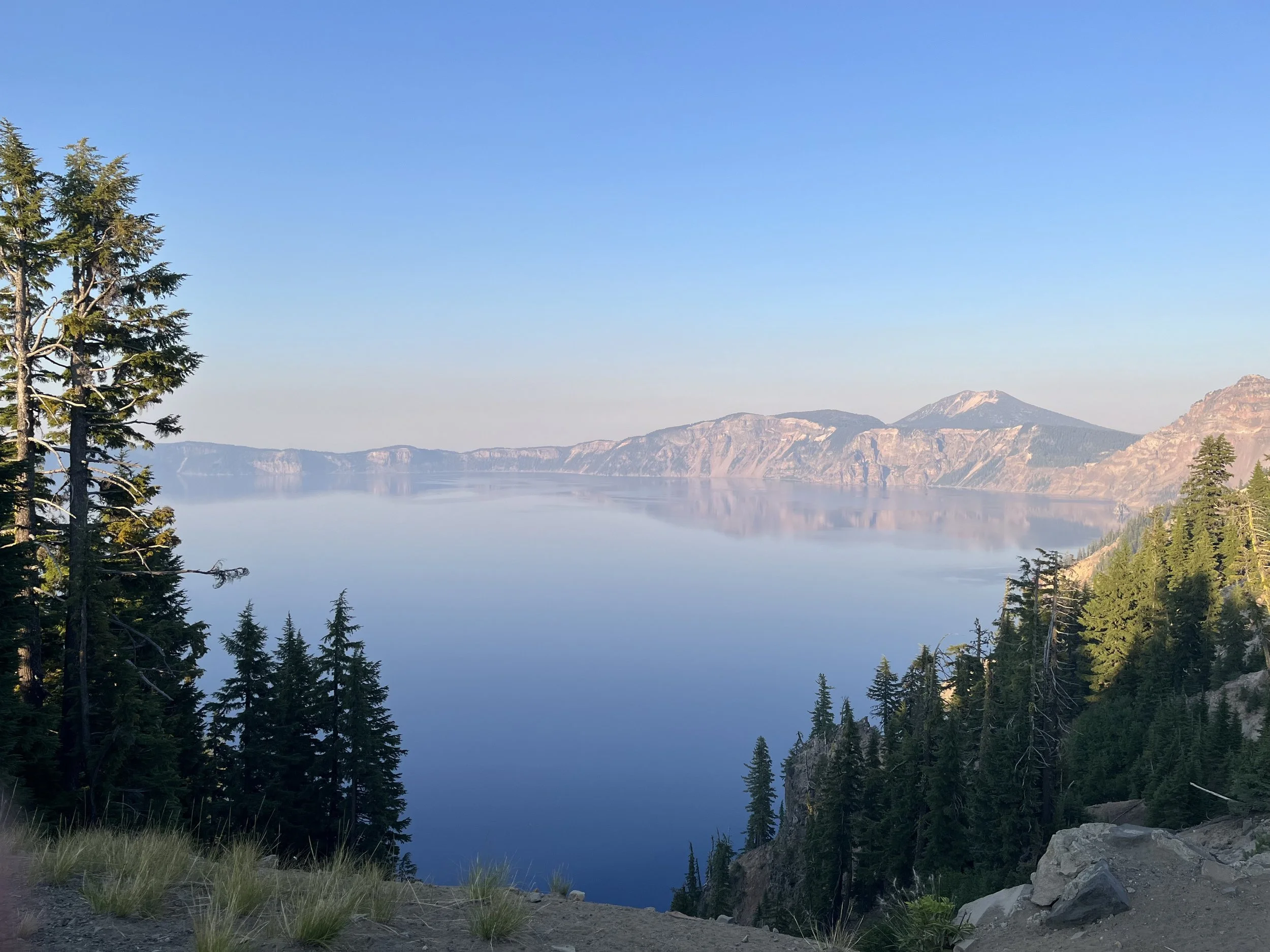
The smoky haze begins to lift from the Crater Lake rim.
Until this month, Paul and I have principally explored the northern half of Oregon: the coast up to Astoria, hiking and activity in the Columbia Gorge, wine tasting in the Willamette Valley, plenty of board meetings in Salem, and outdoorsing in the Wallowas. A few events have taken us to more central latitudes: gathering of the clergy orders in Bend, Youth Winter Camp at Suttle Lake, and half-marathons in Corvallis and Newport. Apart from a quick trip to the Eugene marathon, we’ve hardly gone much south of Highway 20.
This summer break we sought to venture further afield – quite nearly to California – to find renewal in the striking blue of Crater Lake and the creativity of the Oregon Shakespeare Festival in Ashland.
The only problem was our timing.
We had delayed our trip to southern Oregon to August, which meant the near inevitable reality of racing to escape wildfire smoke and triple digit temperatures. The elevation of our camp in the Crater Lake National Park was a great boon in this, but looking out beyond the rim of the caldera revealed a thick layer of smoke settled below the Cascade Range.
At one point, cellular service broke through to send a Red Flag alert saying that conditions were particularly dangerous for the possibility of new wildfire starts in the area. New wildfires! Mercy. As the smoke began to lift with a shift in the wind, we knew the fires to the north to which the smoke belonged were not yet contained. Our minds turned to colleagues and friends in areas where the alerts were not pre-emptive warnings, as we had received, but imminent evacuation directives.
We thought especially of our neighbors to the northeast in Spokane, Washington- part of my home state and sending Annual Conference of the Pacific Northwest.
While we were out in our tent enjoying cool mornings or tasting natural wines in southern Oregon, our colleagues and their teams were evacuating their homes, making alternative plans for worship, providing care for their congregations, coordinating with area leaders and governmental officials, and checking every update on the danger surrounding them.
Our hearts pulled toward them. Part of Paul’s last role was coordinating disaster recovery, so we knew something of the movements these communities were going through. It made us ache for them even more.
Back then, every season was disaster recovery season. If we hadn’t been hit by a hurricane or tornado that year, a neighboring county or state would be. Louisiana and Texas were often exchanging who deployed relief teams to whom based on the storm calendar. The damage caused by each one took not just months but multiple years to recover from. We knew this would be the case for our neighbors evacuating from their homes in Spokane, too.
Even as we have grieved with them, we have also been bolstered by hope. Watching from afar, I am heartened by the leadership and community strength that I have witnessed there. When the world around them was literally on fire, I saw faithful United Methodists checking in on one another, providing compassionate spiritual and grief care, establishing shelters outside of the evacuation zones, and coordinating response before they could even return to their own homes.
After he had evacuated his own home, Rev. Geoff Helton of Audubon Park UMC wrote, “we are not people who grieve without hope. Scripture reminds us that God is ‘our refuge and strength, a very present help in trouble—even when the earth gives way.’ Right now, faith does not demand that we have neat answers or suppress our grief. It gives us permission to weep, to process, and to hold tightly to one another trusting that God is holding us too.
We are not a people who grieve without hope. We are a people who show up at each other's doors with casseroles and box fans and spare rooms. That instinct is already alive in you. I've heard about it happening in the last two days. Keep doing it.”
Now two weeks after the Spokane area fires began, all current evacuations in the area have lifted. One projection shows that the incredibly hard work of the fire crews mitigated damages to just 7% of the structures in the area that were at risk, but that still amounts to more than 800 structures across 10,000 acres- most of them homes.
As our Spokane neighbors return to their homes – or to witness where their homes once stood – our United Methodist connection will continue to support them. As Bishop Cedrick shared in his letter last week, there are four clear ways to lend our strength to theirs:
1) Pray: for the survivors, for the first responders, for everyone impacted.
2) Donate. Give to the UMCOR advance or more directly to the PNW Conference Disaster Response Fund, which helps our disaster response coordinators in times like these.
3) Train and learn when the opportunities arise:
i) Become an Early Response Team (ERT) member. Attend the basic training course Sept. 26 at Des Moines UMC in Washington. This training prepares you to clean out a flooded home, haul debris, sort ashes, and work alongside survivors while staying safe. Read more and register here. Once trained, Early Response Teams can then be sent to areas such as Spokane to help with recovery. Previously trained ERTs will be in Spokane later this month.
ii) Help your congregation be ready to respond in times of strife through the Connecting Neighbors program. The next training will take place Sept. 19 at Beaverton First UMC. Read more and register here.
4) Collect supplies. Answer the call with your congregation when relief supplies are requested (we will update the congregation when this is the case).
If you are interested in coordinating supply gathering, training to become an Early Response Team member, or doing the Connecting Neighbors program, please also let one of the pastors know so that we can coordinate with you.
When our world is literally on fire, United Methodists know what to do: we are moved by God to connect, care, and rely on one another.
As the Spokane Area fires are continually contained, the Grasshopper and Little Giant fires in Oregon and Washington draw our concerns. This wildfire season is not over. Our work together to care for grieving communities has just begun. The instinct is already alive in us. Let’s keep doing it.
Hand in hand,
Pastor Karyn